Foreword
Before you read you should know I did not proof read or AI anything, so no haiting on grammar or typos, its as organized as my camp right no so just warning, thanks, you may continue.
The now: why am I sitting on a sofa in stead of heading out in the mountains
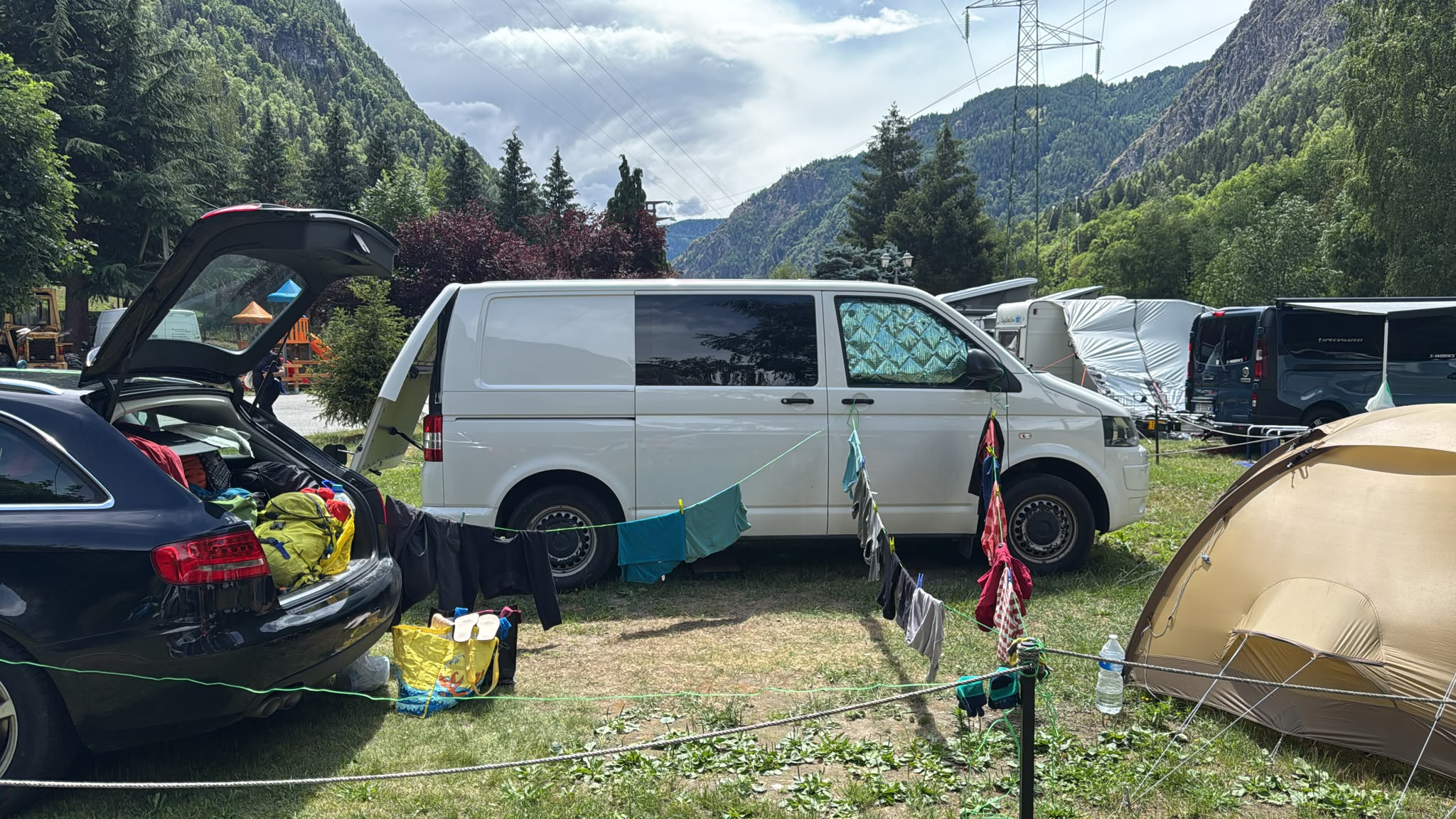
I sit at a community room sofa at a camp ground 30 minutes from Breuil-Cervinia. It’s about 35 degrees, bluebird in the forecast for the next three days. I’m well acclimitized and I feel fit. My legs feel strong, probably due to all the ski carrying I was hating on this past winter in Norway. Climbing feels like flying tho I have been training for skiing the past two years. In the outside everything is perfect for tackling unfinished business with the Matterhorn traverse.
Except that I don’t want to go climbing. I’m not psyched. I’m scared but I don’t know of what. I’m quite tuned to reading the signals my nearvous system sends me, activation of the sympathetic and parasympathetic systems, and very well read on dealing with trauma and stress. I sleep well and the non scientific sport watch gives me normal HRV and high training rediness. But still now that I’m sitting on a sofa complitely safe, my nearvous system it’s alerting me of danger. So let’s dive into the inside.
The mountain guide school taught me to assess how my “me” is doing so lets do that
In the mountain guide school we have been taught to always before heading to the mountains think about how the “I” or “me” is doing. This is in addition to checking it with your guests condition, the mountain conditions and terrain, and the legal system. The last three are more tangiable, easy. But how to asses how I’m doing when it’s so… obscure.
So here is what’s happening: I’m experiencing post traumatic stress from recent rock fall incidents but I’m also reeling from things from my past. This is why, at the moment, I’m not ok with exposing myself to rock fall or climbing under other people in alpine terrain. The best way to describe is I’m not psyched to climb at all and I am always psyched. This is why I’m not on my way up Lions ridge to Matterhorn right now.
What I know about trauma, feelings and myself
This is not my first rodeo on the post traumatic stress department. I’ve had my share of what I consider close calls (most while driving, not in the mountains), I’ve been in an avalanche and I’ve lost people I know. I’ve regognized experiencing post traumatic stress before and dealt with it. I know to feel the feelings instead of ignore them. In my life in general I feel psyched, happy, safe, loved, belonging – all the good things. My special power is positive outlook in life and strong reselience (I got lucky with the brain chemicals). My window of tolerance is so huge I very rarely feel like I’m not in it. I can go to hyperarausal (fight or flight) quickly but I also get my self out of it. Going to a hypoarousal state is very rare for me but I also regognize it easily and can get myself out.
What I know about the mountain guide profession
I’ve chosen to pursue a professional career in the mountains so I have chosen to expose myself to the mountain environment more than as a recriational climber. For me it’s not a choise but a path that I’ve been on always.
In choosing this career I have chosen to be partly driven by outside motivators like the application process to the AMGA and SBO and all the training hours I need to log to learn the mountain guide craft. There is a timeline for this all so it’s not like I can wait for the perfect conditions always. I’ve learned that the most dangerous time for me was supposed to be collecting the application ticklist but up to this point it has evidently and statistically not been so.
But I have learned that one aspirant guide dies every year. I know about all the recent and not so recent deaths of professionals. I’ve read this article https://www.ledauphine.com/societe/2026/03/28/on-en-meurt-la-communaute-montagnarde-doit-en-finir-avec-la-culture-du-risque about guides basically whistley blowing their own culture. Please correct me if I’m wrong in all this because I’de rather be. Our mountain culture glorifies high stakes and exposing one self to objective hazards.
I accept all this as part of what I’m going into. I try to be very explicit and careful about how I express myself and what I’m doing. If what I do seems like it’s not calculated, please call me out.
So what’s the problem with the “me” right now?
I believe it ties into not having control (because I like control so so much) and feeling unsafe (which ties to trauma). I have dealt with close calls before but never so many similar kind back to back. It’s like no matter wehat decisions I make, I end up exposing myself to rock fall. In addition I feel like all the scary things that have happened to me in climbing before are being poured into my cup at the same time. Even things that I thought I have prosessed and should be in the clear.
The underlying reasons: the past experiences and me
Let’s start with the past experiences that shaped my mistrust in the course systems the most: the rock climbing instructor course.
I was 26–29 years old when I did climbing supervisor, sport climbing instructor, ice climbing instructor and rock climbing instructor education. In total this is about 35 days of being in a course setting. My self worth system used to be mostly based on doing things right, obeying the rules and the authority. So having to listen to sexist language, dealing with macho culture (an instructor would not shake my hand or introduse themselves), and see male instructors behave in a way that is not appropriate was probably more stressful for me than for someone else because of what kind of person I am.
In the rock climbing instructor course I felt unsafe because I was told to do things which in my opinion were not safe or appropriate. Here are a few examples. I was sent out to lead a 500m 6b partially bolted route with someone who bailed on a trad 5. It was obvious for me in the evening of getting the assignment that we were put to fail to learn a lesson. On the route I watched my climbing partner jumar a half rope for several pitches. If you don’t understan how incredibly dangerous this is, understand that you should use a single rated preferably static rope with a rope protector over the sharp edges. A thin half rope stretches and could have easily cut over the sharp edges from the back and forth movement of jumaring.
I also watched a rock threaded with a rope explode due to too much force from a sideways pull. This was during a rescue training scenario and the ropeteam attached to the piece fell down until next piece luckily held and caught their weight. I had also been told to use the thread but refused because I did not think it was solid. Right after my prusik failed while I was tandem abseiling and my friend and I were rescued by a back up knot. Bck up knots were also something I have been frequently told not to use because back up knots “slows things down”.
It took me quite a lot of determination and will strength to refuse to do something an 15 years older male instructor tells me to do on the course (because my self worth system – I wanted to obey authority). I had so little trust in the safety towards the end of the course that when catepillaring one day I asked my team to fix the rope so I could ascent it instead of belaying me because I was thinking they are less lickely to fuck up a figure of 8 on a bight than the belay system. The locking carabiner gate was open ofc.
Back then the instructor program was known for lack of safety process, instructor refusing to wear a helmet, accidents and close calls in the A2 solo aid test. My evaluator for example was drinking hard alcohol while observing me climb. There were no back up ropes in the rescue exam or any other situation. “People die in wars” was what I was told, as a joke I’m sure but.
Just so that the story is told right from now on: I eventually gave my opinion about the instructors and the whole program not so professionally and loud and clear. Some years later I started instructing the program myself. So the program has changed and I’ve had corrective emotional experiences since then but not enough. I wrote about my experience to become an RCI here in Finnish.
The wft it’s 2026 and I still need to deal with this woman thing too, it’s getting old
In the past 10 years I’ve had several people tell me several times that the mountains are not a place for a woman, last random insidents in 2024 and 2025. I’ve heard this from my boyfriend, people I kind of know and from random people. I know this sounds like an old story and I was already tired of talking about it but then 5 weeks ago I listened to a friend of mine tell her story about being a woman in the mountains. I started crying because she was telling “my story”.
So there is still a lot of emotion bundled up inside me that I have not dealt with. More CEE is still needed for me to feel safe and right now I’m getting tons of it from my class and the SBO instructors. Every evening spent hanging out together, every invitation I get to climb or ski, every handshake, hug and fist bump is sign of validation for me that I belong in here.
Finnish people, shame on you. If you hear someone talk down on a woman, speak the fuck out. It’s the loud 0.1% who talks but the actual problem is you 99.9% laughing or staying quiet. We want more women here and it will only happen by actively fighting against the 0.1%. It’s usually middle aged men. I have to pass a huge thanks to my SBO class; I know you are not gonna stay quiet.
The chain of events in the past 5 weeks that paved the way for why I write
So first I got post traumatic stress reaction in the rock guide course 5 weeks ago. It took me some time to realize what’s happening. I know it’s trauma based because while traveling to the course I felt excited and relaxed. On the first night of the course my nearvous system went into alert mode and stayed there for almost the whole course.
Interestingly it calmed down when I climbed and got worse when I have time to relax which is during the night unfortunately. I did not sleep well and had hard time eating, except when I was climbing. I had strong flash backs from the RCI course module in the Dolomites. There too I was scared and the only time I felt in control was when I was climbing. My strategy there too was to eat as often as I could while I was climbing. Strange.
On the last day of the Rock guide course I had been fighting my sympathetic nervous system activating constantly and sending me signals of danger for 5 days. The smallest things would trigger the fight or flight. The exchauston after the course was grazy.
After the course I traveled to the Alps and had good rest along the way. I kept processing the RCI stuff and had some flash backs. Going to Chamonix feels like going to my summer cottage, relaxing. Hanging out with my class gives me a lot of positive feels and I felt safe going into the alpine course environment. I did not feel stress in the alpine guiding course, probably thanks to the corrective emotional experience I had in the Lofoten rock guide course, good introduction talk from the guides teaching the course and because summer alpine is my thing.
The first rock falls and how good decision making brings back my confidence
On the last day of the Alpine guide course I witnessed two rock falls. Rockfall is the main hazard in the alpine so I took the events initially quite calmly. I can see the flash back of one of the rocks bounsing but I was not scared to go back into the alpine to climb right after the course with my friend Henna.
Henna and I went to Trient hut first and observed the conditions while climbing the Dorées traverse. No refreeze, rotten snow, just awfull conditions. I’m doing these routes also for training and decided we try to find routes in lower alpine with no overhead hazard and steep snow travel. A recommendation took us to Ailefroide and the traverse of the Sialouze. I felt in control going in and being calculative with route choise and what hazard we expose ourselves to.
In addition I felt good making the decision early on to not consider going to the Forbes aréte and the Meije traverse, tho these routes were are on the top of our list. I was happy about how good I am at collecting data for decision making myself, compairing weather forecast and nailing the little windows of no thunderstorms. We had no problems or stress with weather tho it’s usually my biggest stress factor.
How all goes to shit at the Sialouze traverse in 15 minutes: the second rock falls and some random cherries
Firstly I slept poorly in the hut. It just sometimes happens, no drama, but I and my nearvous system was going into the day a bit tired when we start the day around 4.30.
After 30 minutes of hiking in a woman in a guided group slips and falls on a slab. She is slipping down to rocky terrain where she could potentially hurt herself. It’s dark and I can just imagine how scary it is for her to loose control like that. I take a few seconds to asses, quickly pass the other other clients, test the snow slope leading to her so I know I can safely approach her from below and move under her.
I lay on the slab like a seal, push her with my other hand and hold my own weight with the other. She is shaking hard against my arm. The guide of the group comes in and pulls the woman up as I push her from the back. The guide turns and leaves the rest of the groupe to figure out how to pass the same section. No thank you’s. What was that? This event takes me from half asleep to hight alert in 20 seconds.
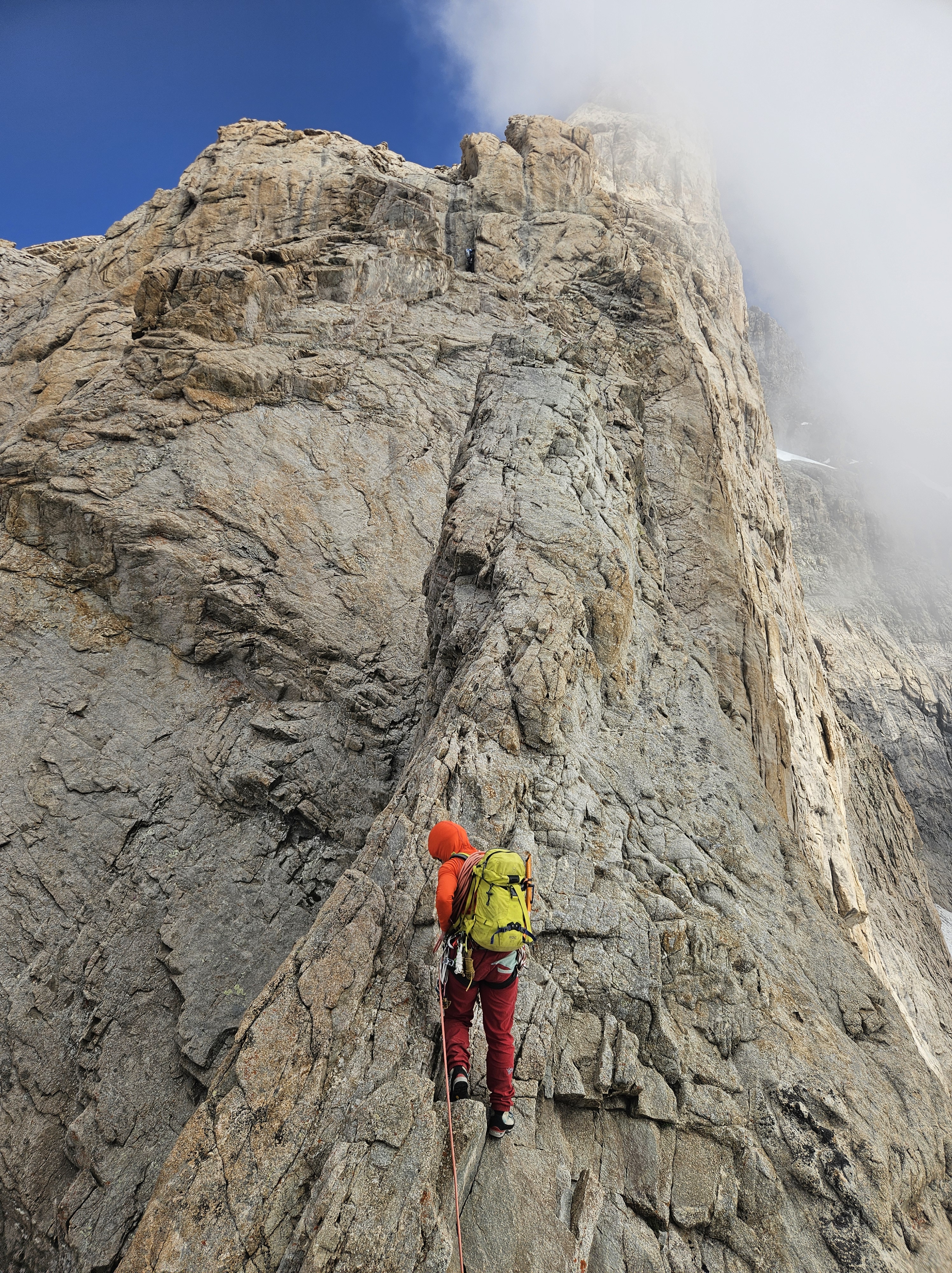
As we get closer to the beginning of the route, I see a red flag. A team climbing with double ripes, 20 meters rope out on what seems to me like short rope terrain. They are pitching where you should not pitch because the terain looks easy and often easy in the beginning of the route in the alpine means loose. We deside to approach the route and as we are ready to start climbing, rocks start flying on us. It’s more like rock ran. Little bebbles and some golf balls. Rocks go everywhere, inside my shirt and pack. This happens 3 times.
When the team seams to be at the next ledge I decide to go. I short rope us up the section almost passing the team. I continue right behind the guys, short roping us up following the guy seconding. They are still pitch climbing. I stop and we talk strategy: I could stay up in the guys ass and try to pass. That way I’m less exposed to falling rock gaining velocity.
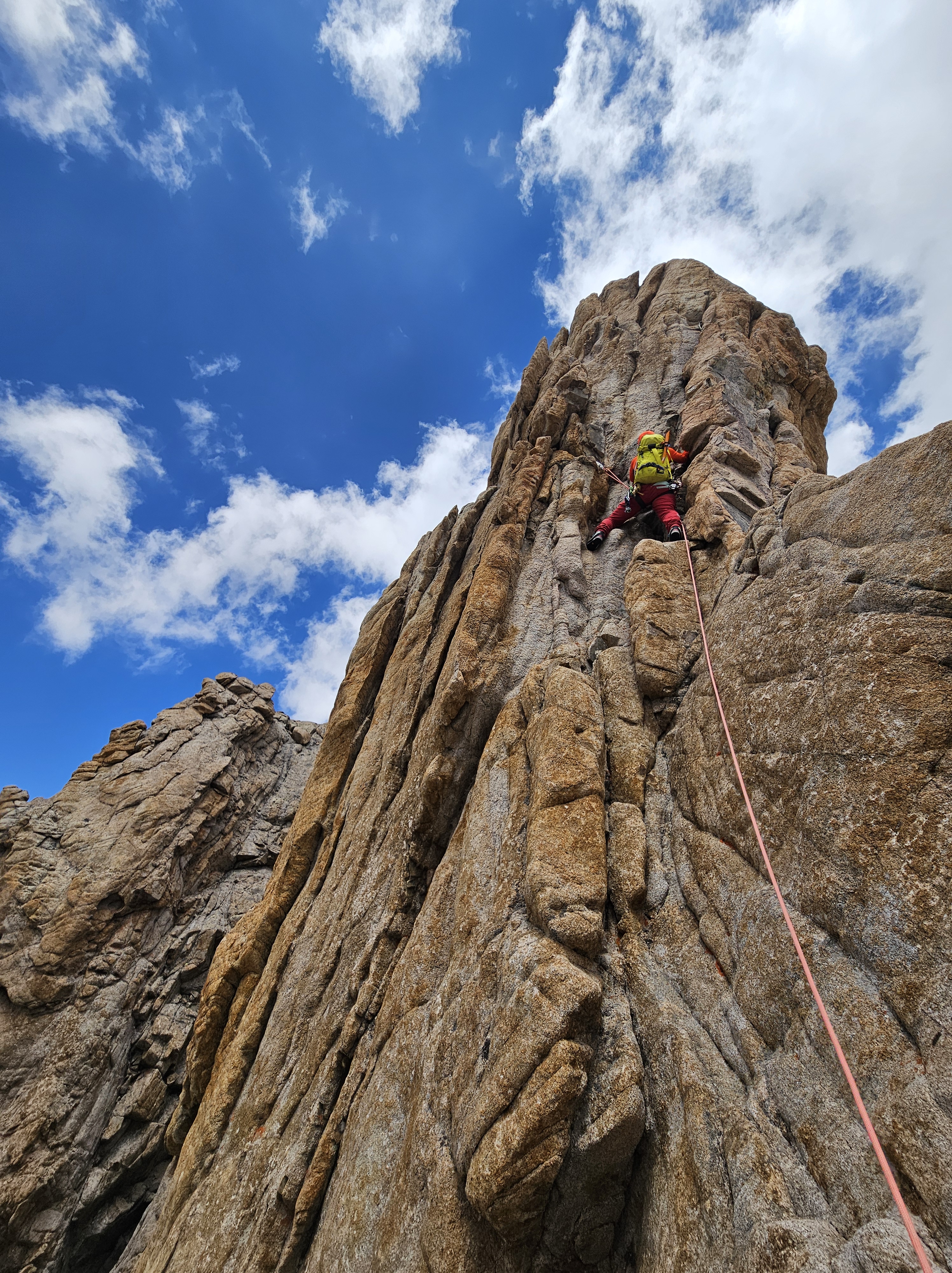
Luckily I think about the two ropes in between the climbers and conclude that the rocks can drop higher up too and gain velocity. Which is exactly what happend a minute later. Had I commited into following this guy, I could have had the next football sice rock cut our rope or hit me with high consequense. The rock almost hit a team below us.
This rockfall was the last straw for my nearvous system that had been taking beatings since the morning, on the alpine guide course and especially on the rock guide course 5 weeks ago. I started shaking and feeling nauseous.
We took a break and I could only say that this is not worth it for me. I have now had close calls with falling rock 7 times in the past 2 weeks. This is not ok in so many levels.
The hardest thing was that I really thought that by coming to this spesific mountain we had mitigated exposure of falling rocks from likely to not likely. We decided to continue but my body did not respond well to climbing that day. An hour from the event I still felt like I was going into a panic attack and I had to use all the coping mechanisms I know to trick my nearvous system to thinking I’m safe.
Then as a cherry on top all this we hear screams of a rope team falling down the Coolidge couloir and watch the heli rescue. They don’t bring a litter, just pick people up so we know that there is no severe injury. Good. And the second cherry is that there is constant spontanious rock fall going down the mountain to the South from the Bréche de Sialouze. It could be that the constant sound of rocks falling down to the valley kept re-triggering the alert mode.
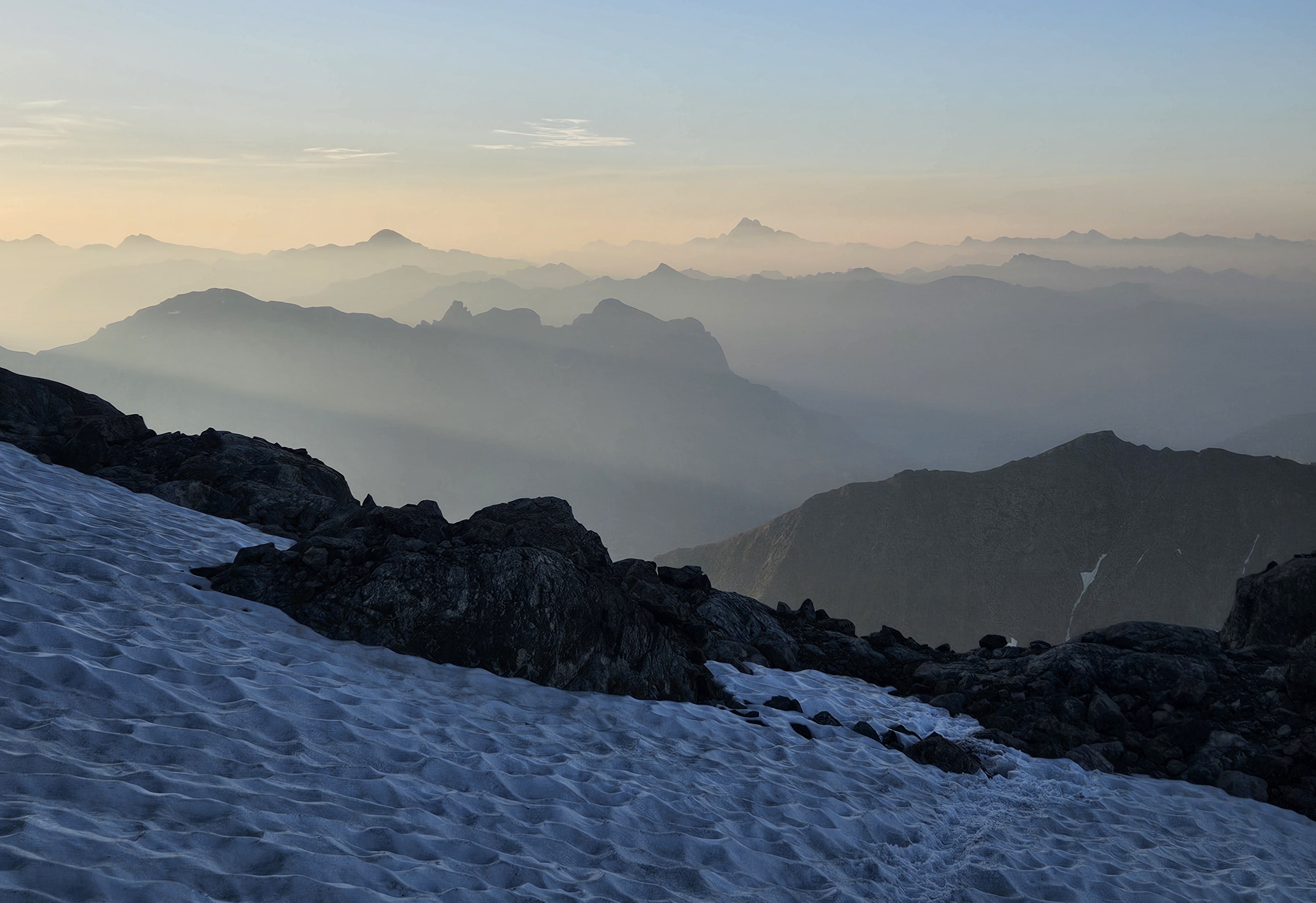
The from now on, what am I doing to reset my nearvous system
Since the Sialouze I have not been able to get my nearvous system off alert mode for more than a few hours at a time. My sympathetic nervous system keeps pushing the alert signal. I know all the tips and tricks to help activate the parasympathetic nervous system so I know what to do.
Things that seem to help me right now is repetitave movement like hiking back down from the hut and getting into a flow state so concentrating on working or writing. So here I am ranting about my feelings. I also talked to a friend from work who validated what I’m experiencing. I was in a desparate need for corrective emotional experience on our trip to Ailefroide and I got the opposite.
I was lucky I had friends from the guide school going up Lions ridge today so I was able to set Henna up with partners in two hours notice so she could still climb. That was a relief.
Some more “me” reflections: I have no fear of missing out. I’m content and happy to not be hiking up to the Carrel hut right now.
But I do hope I get my psyche to climb back. So now I just feel all the feels, and (still) deal with the aftermath of the RCI trauma coming out so strongly (getting pretty old tho so please) and the too many close calls the past few weeks.

Some final learnings from me to the reader, if you are interested (or skip if it feels like splaining :))
Luckily the risk mitigating process is not broken, it works. What happened to me was not (just) poor judgement but bad luck. We don’t expect to find people with such complete lack of skill on alpine climbs graded D. We can make climbing in the alpine reasonably safe. It does require letting go of fixed goals, bailing more often and educating yourself a bit more on conditions and the terrain. Maybe hire a mountain guide for a few days to get the beta (I’m still far from craduating so I’m not advertising here).
The only way to mitigate teams dropping rocks is to wake up before others and be the first one on the route. I live up to this rule and look what happened when I compromized once. Listen to yourself when you see a red flag. Avoid terrain that is suspicious. Here is a great short article about what kind of terrain to avoid: https://alpineclub.org/news/mountain-stability-in-the-mont-blanc-massif-summer-2022
And most importantly, the whole point why I wrote all this: reflect how you are doing before heading out. Climbing is much safer when you are not stressed and can concentrate on the mountain. If the mountain professionals are taught to do it in the mountain guide school, it for sure is benefitial to the recriational climber too.
What’s next for me, like this weekend
I wait my friend to come down from Matterhorn and hopefully hear some fun stories about their climb. I will sleep in, read my (romantasy) book (escapism for the win!), doomscroll insta, post something prolly about the sassy chicken that keeps visiting and call a friend. Then I go back to Chamonix and get invited for dinner (waiting for the request you guys :P) with friends and vent about all this some more or maybe not. Next week I maybe stay in client mode for awhile so guys come take me out.
One final thought that ties into all of what is happening with all the conditions and the hazard of spotanious rock fall in the Alps and what I talk about with my class: I think that the guiding profession is going to change a lot during my education as we inevitably move from a classic alpine climbing season (with set products) into alpine climbing windows (with condition dependent products). Here is a great list of articles about the changes in the Alps: https://chamonix-perspectives.com/insight I look forward to being there in a few years to shape this profession to whatever direction it needs to go.
Until then I keep sharing the journey and all it’s ups and downs. All the feedback I’ve gotten from the school up to this point has been positive so school is going super well. xoxo Emma


